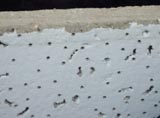
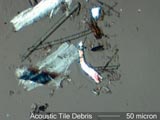
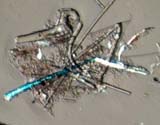
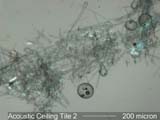
Acoustic ceiling tile that contains glass fiber can be divided into two basic groups by their gross
appearance. The body of the tile is either compact and gray or loose and yellow. The gray tile
exhibits the greatest variability in composition, from nearly 90% glass fiber to about 10% glass fiber.
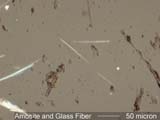
The other materials in the body of the tile may include perolite, paper fiber, clay, calcite, glass
shot, glass blebs, and asbestos. Glass fiber from acoustic ceiling tile is identified by the other
materials still attached to it. Clear epoxy binder, sodium silicate, or similar clear binder containing
small particles of calcite filler and binding the glass fiber to any of the other possible materials
used to make these tiles identifies the glass as coming from acoustic ceiling tile.
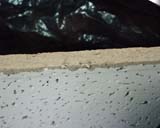


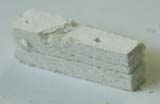
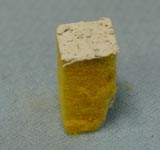
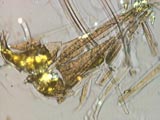
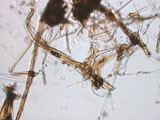
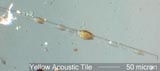
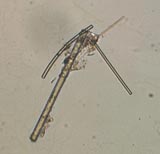
 The yellow bodied acoustic ceiling tile that contains glass fiber is composed of glass fiber and
yellow phenolic resin. The amount of resin and the amount of mineral filler used in the resin varies
from one grade to another and from one manufacturer to another. Glass fiber from yellow bodied
acoustic ceiling tile can often be distinguished from other yellow phenolic bound glass fiber.
Yellow phenolic bound glass fiber from sound board in the HVAC system is generally covered with
small impacted particles of natural minerals, soot, pollens and other airborne particles. Yellow
phenolic bound glass fibers from blanket insulation typically contain much less mineral filler in
the resin. Yellow phenolic bound glass fiber from cubicle divider panels tends to contain much
more yellow resin than the yellow bodied acoustic ceiling tile. See the "Glass Fiber" section of
the gallery for examples of all these materials.
The yellow bodied acoustic ceiling tile that contains glass fiber is composed of glass fiber and
yellow phenolic resin. The amount of resin and the amount of mineral filler used in the resin varies
from one grade to another and from one manufacturer to another. Glass fiber from yellow bodied
acoustic ceiling tile can often be distinguished from other yellow phenolic bound glass fiber.
Yellow phenolic bound glass fiber from sound board in the HVAC system is generally covered with
small impacted particles of natural minerals, soot, pollens and other airborne particles. Yellow
phenolic bound glass fibers from blanket insulation typically contain much less mineral filler in
the resin. Yellow phenolic bound glass fiber from cubicle divider panels tends to contain much
more yellow resin than the yellow bodied acoustic ceiling tile. See the "Glass Fiber" section of
the gallery for examples of all these materials.
|